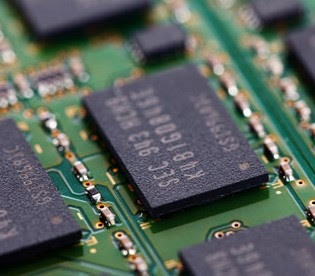
A computer system comprises hardware and software components, aiming to offer a powerful computational tool. These systems play a crucial role across diverse domains, aiding us in numerous tasks. The prevalence of the internet has significantly bolstered the utilization of computers for information sharing and communication. Computer systems empower us to store, process, display, and transmit information. Even in a basic modern computer system, multiple programs are typically required to carry out various functions effectively.

Showing posts with label RAM. Show all posts

Tuesday, October 11, 2022

Read-only memory (ROM)

Memory is the most essential element of a computing system because without it computer can’t perform simple tasks. Computer memory is of two basic types – Primary memory(RAM and ROM) and Secondary memory (hard drive, CD, etc).

ROM devices are used for storage of data that does not require modification. ROM stands for Read-Only Memory. It is a non-volatile memory that is used to stores important information which is used to operate the system. Non-volatile memory (NVM) is a type of computer memory that has the capability to hold saved data even if the power is turned off. Unlike volatile memory, NVM does not require its memory data to be periodically refreshed

While RAM is volatile memory that temporarily stores the files when user is working on, ROM is non-volatile memory that permanently stores instructions for computer.

ROM contains the programming needed to start a computer, which is essential for boot-up; it performs major input/output tasks and holds programs or software instructions.

The memory does not depend on an electric current to save data, instead, data is written to individual cells using binary code. Non-volatile memory is used for parts of the computer that do not change, such as the initial boot-up portion of the software, or the firmware instructions that make the printer run.

Types of Read-Only Memory (ROM):
*MROM (Masked read-only memory)
*PROM (Programmable read-only memory) - It can be programmed by the user. Once programmed, the data and instructions in it cannot be changed.
*EPROM (Erasable programmable read-only memory)
*EEPROM (Electrically erasable programmable read-only memory) - The data can be erased by applying an electric field, with no need for ultraviolet light.
Read-only memory (ROM)

Saturday, August 6, 2022

RAM architecture

In random-access memory (RAM) the memory cells can be accessed for information transfer from any desired random location. That is, the process of locating a word in memory is the same and requires an equal amount of time no matter where the cells are located physically in memory.

Due to RAM architecture, the memory cells can be accessed for information from anywhere on the computer system.

This communication between different peripherals and RAM is achieved by data input and output lines, control lines which specify the direction of transfer, and address selection lines.

The n data input lines deliver the all information which are hold in the memory, and n data output lines transfer the information that is come out of specific word selected among the 2k available. inside the memory.

Types of RAM
*SRAM (Static Random Access Memory) - is made up of four to six transistors. The word static indicates that the memory retains its contents as long as power is being supplied unlike DRAM, which has to be refreshed periodically.
*DRAM (Dynamic Random Access Memory) - is widely used as a computer’s main memory. Each DRAM memory cell is made up of a transistor and a capacitor within an integrated circuit, and a data bit is stored in the capacitor. DRAM must be continually refreshed in order to maintain the data. This is done by placing the memory on a refresh circuit that rewrites the data several hundred times per second.
*VRAM (Video Random Access Memory)
RAM architecture

Tuesday, April 19, 2022

Primary memory

Memory is physically organized as a large number of cells that are capable of storing one bit each. Primary memory is comprised of DRAM (Dynamic RAM) and provides the actual working space to the processor. Primary memory is also known as Main memory or Internal memory, is the area in a computer which stores data and information for fast access.

Primary memory is the main memory of the computer which can be directly accessed by the central processing unit, whereas Secondary memory cannot be accessed directly by a CPU or processor. Secondary memory refers to the external storage device which can be used to store data or information permanently. The memory devices used for primary memory are semiconductor memories.

Generally, primary memory has a storage capacity lesser than secondary memory and greater than cache memory.

As soon as a computer starts, primary memory loads all running applications, including the base operating system (OS), user interface and any user-installed and running software utility. A program/application that is opened in primary memory interacts with the system processor to perform all application-specific tasks.

Random Access Memory (RAM) is primary-volatile memory and Read-Only Memory (ROM) is primary-non-volatile memory. The processor accesses all memory addresses directly, irrespective of word length, making storage and retrieval fast. RAM is the fastest memory available and hence most expensive.
Primary memory

Friday, January 7, 2022

System RAM

RAM is the hardware location in a computer where the operating system, application programs, and data in current use are kept so that they can be quickly reached by the computer's processor. RAM is acronym used for Random Access Memory. RAM is much faster to read from and write to than most other kinds of storage in a computer (the hard disk, floppy disk, and CD-ROM).

When the user opens an application, it is loaded into RAM. RAM can be compared to a person's short-term memory and the hard disk to the long-term memory. The short-term memory focuses on work at hand, but can only keep so many facts in view at one time.

When the user saves a file and close the application, the file is written to the specified storage device, and then it and the application are purged from RAM.

Without RAM it becomes impossible to get very far, from the moment the PC is turned ON. The software applications installed on the computer depends largely on the RAM. It is responsible for holding the data while any application is running. Once the application is closed without saving, the data gets lost.

RAM is called "random access" because any storage location can be accessed directly. Externally, RAM is a chip that comes embedded in a personal computer motherboard with a variable amount of additional modules plugged into motherboard sockets. To add memory to the computer, just simply add more RAM modules in a prescribed configuration.

Whether it comes from permanent storage (the hard drive) or input (the keyboard), most data goes in random access memory (RAM) first. The CPU then stores pieces of data it will need to access, often in a cache, and maintains certain special instructions in the register.

The opposite of RAM is Serial Access Memory (SAM). SAM stores data as a series of memory cells that can only be accessed sequentially. If the data is not at the current location, each memory cell is checked until the needed data is found.
System RAM

Sunday, April 8, 2012

Central Processing Unit

The central processing unit (CPU) is the heart of the computer, where information processing takes place. It is here that all is controlled, all data are manipulated and arithmetic/logic computations are performed.

The CPU typically consists of one large IC or silicon chip called a microprocessor along with a number of smaller ICs that perform support functions.

Microprocessor are made of silicon embedded with transistor. A transistor is a semiconductor, a component that can serve as either a conductor or an insulator, depending on the voltage of electricity that tries to flow through it.

The CPU is comprised of three parts:
*Arithmetic and logic unit (ALU)
*Control Unit
*Primary memory

The arithmetic logic unit is capable of performing relatively simple arithmetic or logical operations on data such as adding two numbers, subtracting one number from another, comparing two numbers and so on.

Logic functions are used to compare values. They are >=, <=, =, <, > and < >.All computer applications from typing a document to supercomputer simulation are achieved through these simple operations.

The control unit coordinates the various operations specified by the program instruction. These operations include receiving data, which enter the computer, and deciding how and when the data should be processed.

It moves instruction from the memory to the registers in the control unit. The control unit executes only one instruction at a time and executes it so quickly that the control unit appears to do many things simultaneously.

Both the control unit and the ALU make use of registers to perform their function. Computer registers are small memory units in the CPU that can receive, hold and transfer data. All programs must be loaded into main memory before they can be executed.

The central processing unit capacity is often described in word sizes. The word is the number of bits (such as 16, 32, or 64) that can be processed at one time by the central processing unit.

The number of bits in the registers constitutes the computers word length, which can indicate to a certain degree the processing capability of the computer.

Therefore, the more bits of the word size, the more powerful is the CPU or central processing unit. The more powerful the CPU, the faster the computer.

Data and instruction are stored temporarily in the primary memory or primary storage unit. This part of temporary is called random access memory (RAM).
Central Processing Unit

The Most Popular Posts

  • Xanthones are a distinctive class of naturally occurring organic compounds known for their unusual chemical structure and diverse biological activities. ...
  • Basmati rice is one of the world’s most distinctive rice varieties, celebrated for its long, slender grains, delicate flavour, and characteristic fragran...